

Our Services
 Phase 1 Environmental Site Assessments (ESA) are conducted to identify and document the current and past environmental conditions of a property with respect to contaminants from petroleum products or within the scope of the Comprehensive Environmental Response, Compensation and Liability Act (CERCLA).
Our Phase 1 ESAs are conducted in accordance with the American Society for Testing and Materials (ASTM) Standard Practice E1527-05.
 QI’s staff of industrial hygienists take a comprehensive approach to performing mold and moisture assessments, as many factors must be considered when trying to identify the source of contamination.
Our industrial hygienists are experienced in locating potential water intrusion sources, measuring airborne mold concentrations, identifying mold growth, and providing sensible solutions for the cleaning or removal of the mold.
 The American Industrial Hygiene Association (AIHA) defines industrial hygiene as:
“The science and art devoted to the recognition, evaluation and control of those environmental factors or stresses, arising in or from the work place, which may cause sickness, impaired health and well-being, or significant discomfort and inefficiency among workers or among the citizens of the community.”
EQI works with each client to evaluate and control the environmental factors and stresses that may impact their business and employees. Once EQI and our client develop a plan to address these factors, our industrial hygienists determine if exposure monitoring is necessary and what type of sampling is necessary to meet the requirements of OSHA’s 1910.1000 standard.
EQI’s goal is to help our client protect their work force while increasing productivity and reducing industry liability.
 Inspections for asbestos, lead and other hazardous materials are performed by EQI’s experienced Hawaii Department of Health (HDOH) certified and U.S. Environmental Protection Agency (EPA) accredited inspectors.
EQI has performed thousands of inspections across the Pacific of single-family homes, hospitals, hotels, airports, schools, commercial buildings and entire military housing communities.
Once the inspection has been completed, EQI assists our clients in interpreting and complying with the increasingly complex regulations.

Asbestos-containing materials, lead-based paints, arsenic, and polychlorinated biphenyls are just a few of the hazardous materials which must be addressed prior to a building renovation or demolition.
Working closely with our architectural and engineering clients, EQI develops abatement strategies for integration into the overall project specification.
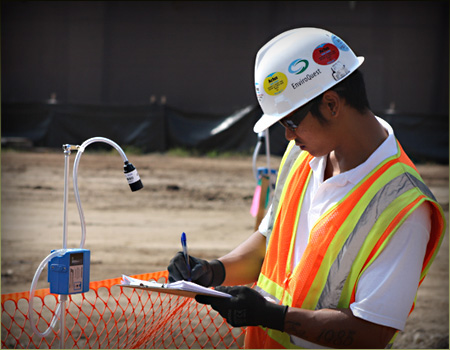 Abatement monitoring services are designed to help our clients manage the day-to-day aspects of a hazardous material abatement project.
EQI asists our clients by conducting daily inspections, documenting work practices, collecting dailiy air samples, conducting final visual inspections and collecting clearance samples.